
Severe illness during pregnancy may do more than affect the mother’s health. Research suggests that a strong immune response during pregnancy can also influence how a baby’s brain develops.
A new study from the Salk Institute offers more detail on how this may happen, pointing to changes in the epigenome, the system that controls how genes work without changing the genetic code itself.
Neurodevelopmental conditions such as autism spectrum disorder (ASD) and attention-deficit/hyperactivity disorder (ADHD) affect about 10% of the U.S. population. Scientists still have many questions about when these conditions begin and what factors shape their development.
Maternal illness and immune activity during pregnancy are among the areas receiving growing attention.
What Researchers Found
Salk Institute researchers studied the frontal cortex of developing mice whose mothers had either a normal pregnancy or an immune response triggered during pregnancy. The researchers tracked epigenetic changes from fetal development through the early weeks after birth.
The findings, published in Molecular Psychiatry, showed thousands of epigenetic differences between the two groups. The most noticeable changes appeared in deep-layer neurons, which play important roles in brain development and communication.
Many of the altered regions were located near genes associated with autism spectrum disorder. The results also suggested that prenatal immune activation can affect brain circuitry in ways that remain detectable after birth and into adulthood.
The findings do not mean that an illness during pregnancy directly causes a neurodevelopmental disorder. Instead, they suggest that strong immune activity can change the biological conditions involved in brain development and may increase the odds of later problems.
Why Maternal Illness Matters

Gemini | Decades of research link prenatal infections like the flu to a higher risk of psychiatric disorders in offspring.
The connection between illness during pregnancy and later mental health outcomes is not new. Researchers first noticed the pattern decades ago when studies linked influenza infections during the second or third trimester with a higher rate of psychiatric disorders among offspring.
Later research offered a possible explanation. Scientists examining blood samples from mothers found that the immune response to infection, rather than the infection alone, may play an important role.
One molecule received particular attention: interleukin-6, or IL-6. This protein helps regulate inflammation during an immune response. Higher IL-6 levels in the maternal bloodstream gave researchers a way to study how immune activation might affect fetal brain development.
Scientists then developed animal models that could reproduce some aspects of this process. Margarita Behrens, Ph.D., a research professor at Salk, explained that researchers had already studied the model through behavior and electrical activity in the brain.
The newer study focused on epigenetic changes that could help explain those observations.
How the Mouse Study Worked
The Salk team used Poly(I), also known as polyinosinic acid, to mimic the immune response associated with a viral infection. This model is called Poly(I) maternal immune activation, or PIC-MIA.
Researchers examined neurons in the mouse frontal cortex from mid-gestation through two weeks after birth. They measured changes in gene activity and DNA methylation, a type of epigenetic modification.
DNA methylation involves adding small chemical groups called methyl groups to DNA. These tags can affect whether certain genes remain active or become less active. Unlike the DNA sequence itself, epigenetic patterns can change in response to environmental conditions.
The mice from PIC-MIA pregnancies showed clear differences in both gene activity and methylation. The strongest changes appeared in regions involved in the development of deep-layer neurons.
Tbr1 and Deep-Layer Neurons
One of the most important findings involved Tbr1, a transcription factor that helps guide the development of the fetal brain.
At birth, researchers found increased methylation at areas where Tbr1 normally binds in deep-layer neuron regions. At the same time, Tbr1 levels were higher than expected. Despite that increase, genes normally regulated by Tbr1 showed reduced activity.
The researchers believe increased methylation may have interfered with Tbr1’s ability to perform its normal role in defining deep-layer neurons.
The finding became more significant when researchers compared their results with the SFARI Gene Database, a widely used resource containing genes associated with autism spectrum disorder. Jessica Arzavala, co-first author of the study and a graduate student researcher in Behrens’s lab, said that about 25% of the high-confidence autism-associated genes in the database also showed dysregulation in the study’s dataset.
That overlap does not establish a direct cause of autism. However, it gives researchers a clearer target for studying how prenatal immune activity may affect brain development.
Brain Function Also Changed
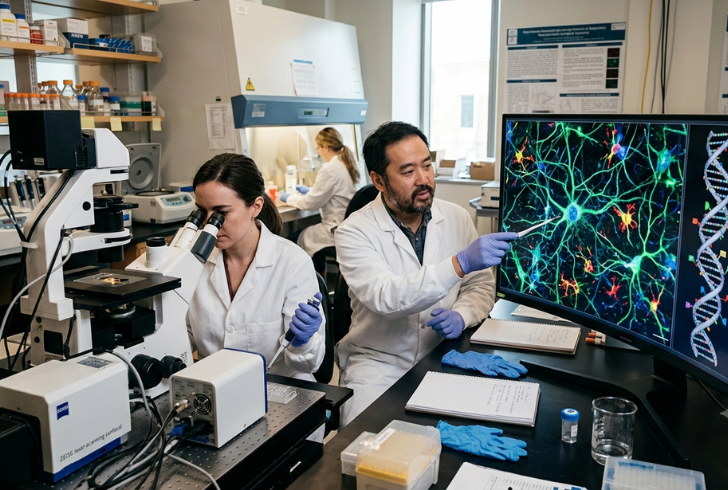
Gemini AI | Researchers are studying how immune activity during pregnancy may affect developing brain cells and shape brain function later in life.
The researchers did not stop at gene activity and methylation. After birth, they recorded the electrical activity of deep-layer neurons to see whether the observed molecular changes also affected how the cells functioned.
The results supported the earlier findings. Offspring exposed to maternal immune activation showed impaired development in deep-layer neurons.
Joseph Ecker, Ph.D., a professor and Salk International Council Chair in Genetics at Salk and a Howard Hughes Medical Institute investigator, emphasized an important point: infection changes the odds of neurodevelopmental effects, but it does not mean that every mother who becomes sick during pregnancy will have a child with a neurodevelopmental disorder.
That distinction matters because neurodevelopment results from many interacting genetic and environmental factors.
What the Findings Mean
The study gives researchers another way to examine the biological effects of maternal illness. Instead of looking only at behavior or brain activity after birth, scientists can now study molecular changes that may appear during fetal development.
Still, several questions remain. Researchers do not yet know exactly when these epigenetic changes begin, how long they last, or whether certain stages of pregnancy carry greater vulnerability to immune challenges.
Behrens described the current findings as only the beginning of a much larger research effort. Ecker similarly noted that scientists are getting closer to understanding the consequences of maternal infection but still have much to learn.
Maternal immune activation appears to be one factor that can influence the biological processes involved in fetal brain development. The Salk Institute study connects immune activity with changes in DNA methylation, gene regulation and deep-layer neuron function.
The research does not suggest a simple cause-and-effect relationship between illness during pregnancy and neurodevelopmental disorders. Instead, it adds evidence that prenatal immune responses may alter brain development through epigenetic mechanisms.
As researchers continue to identify when these changes occur and which brain cells are most affected, the findings may help clarify how early developmental risks take shape.